The need for science to be shared more widely with the world of lay persons has become urgent, says S.Ananthanarayanan.
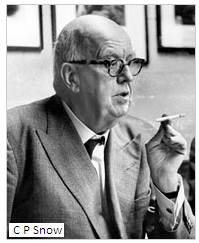
In 1959, the thinker and writer, CP Snow, while speaking about people trained almost exclusively in the sciences or in the humanities, said this had created two cultures. “.. the great edifice of modern physics goes up, and the majority of the cleverest people in the western world have about as much insight into it as their Neolithic ancestors … ”, he said. Since then, however, with the advance of science and its increasing role in daily affairs, there has been positive effort to communicate scientific knowledge to a larger audience.
For all that, based on a study of the reader-friendliness of the summaries of reports of the Intergovernmental Panel on Climate Change (IPCC), there has been a remark that the “top level documents of the panel are harder to understand than a paper by Albert Einstein.” As the IPCC is the UN sponsored intergovernmental, which is to say, neutral and global agency to study climate change, the criticism is a serious one. But Thomas F. Stocker and Gian-Kasper Plattner, researchers in Climate Change from Switzerland, in a letter to the journal, Nature, disagree with the study and say the features of the latest summaries, which are designed to assist the non-specialist reader, have been overlooked while making the assessment.
The study in question is a paper in the journal,Nature Climate Change, which notes that the Summary for Policymakers (SPM) of the IPCC reports was the most widely read part of the reports and acted as the ‘springboard’ for their communication. Building on existing findings, which say that both the IPCC as well as mass media are challenged in conveying the content of the reports to non-scientific and even some scientific audiences, the researchers used popular tools, the Flesch Reading Ease (FRE) algorithm to assess ‘readability’ and a software, DICTION, to assess the ‘sentiment content’ of the SPM of IPCC reports.
The DICTION software analyses the use of words and word combinations in a piece of text and is able to largely succeed in evaluating the ‘tone’, or, in our context, the ‘degree of optimism’ in what the author is saying. FRE, however, is based on the length of sentences and the number of syllables in words used. The principle, which was laid down by and L A Sherman, an English professor, is that as short sentences and concrete terms, like we use in speech, are easier to understand, writing is easier to read if it is more like speech. A number of researchers, including Rudolf Flesch, analysed universally accepted ‘highly readable’ texts, the Bible, for example, and arrived at a formula to assess ‘readability’. The process is to count the number of sentences and words, to work out the ASL, average sentence length, and then to count the total number of syllables in all the words, to get the ASW – the average number of syllables in a word. FRE, the Flesch Reading Ease score is then given as:
FRE = 206.835 – ( 1.015 x ASL) – ( 84.6 x ASW).
The scores can be in a range from negative numbers, rising to 120, for the simplest sentence, with only two one syllable words. The sentence, "The cat sat on the mat," has a score of 116 The general interpretation is shown in the table
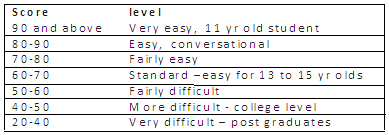
This simple formula, which yields higher scores for text with short sentences and short words, has been found to correctly reflect how actual readers find the text and has become a standard, particularly in publishing and journalism and also for design of instruction manuals, Income Tax forms, etc., which need to be clearly understood.

FRE of the Summaries
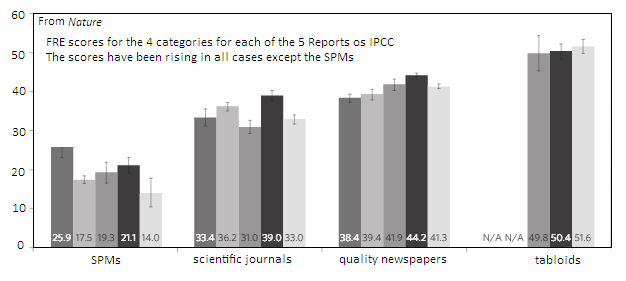
DICTION and FRE scores of SPMs of the IPCC reports were thus estimated and compared with the scores of the same matter as reported in popular and scientific publications, between the year 1990 and 2014. The scientific journals were Nature and Science, the quality newspapers were New York Times, Washington Post, The Independent and The Times and the tabloids were Daily News, The Mirror The Sun. The results of DICTION were that the level of pessimism increased as one passed from SPM to tabloid, which is understandable, as the SPM was only factual, while the other media need to interpret and progressively to sensationalise. The results of FRE, as shown in the bar chart, are that the SPMs have the lowest scores and worse than that, while the scores of other publications have improved over the years, the scores of the SPMs have gone down. The findings were thus a serious indictment of the SPMs and a suggestion that improvement of presentation may be of great benefit.
Stocker and Plattner, in their letter to Nature, have a particular bone to pick about the last of the observations made above, viz, that the SPMs have not improved but have worsened. While it is evident there would be a less ‘conversational’ style in a scientific journal or even a conservative newspaper, in the case of the SPMs these are documents summarizing purely scientific findings and are charged not to be judgmental or show any bias. The authors, nevertheless, have been alive to the fact that an important section of the readers are non- technical persons who decide government policy. As it is vital that the import of the reports be communicated to them, the latest of the SPMs have incorporated a new communication tool, so called headline statements, in distinct font and colours. While succinct descriptions were there in previous SPMs too, every section and subsection of the SPM of the report by Working Group No.1 has a headline statement in simple language, without complexity or jargon. Taken together, Stocker and Plattner say, the headline statements provide a coherent summary of the whole 1,535 page scientific report in just two pages.
Headline statements were not used with the SPMs of repots by Working Groups II and III, but have been used for the IPCC Synthesis report, both in the SPM and the full report, they say. The Nature Climate Change paper does not seem to have considered the value of this addition in their analysis, but has routinely subjected the headline statements to the statistical word- counting of FRE, along with the much longer SPM. Stocker and Plattner also compare the FRE of headline statements with the remaining part of the reports and also the reference journals used. They find that the readability score of the headline statements are far superior to the reports and also the mean of the scientific journals and only below the quality newspapers. “ This …. strongly suggests that carefully crafted, critically discussed and iteratively refined headline statements can indeed be a way to make the major findings collected in the SPM more comprehensible and accessible,” the correspondents say. While they do agree with the earlier study that IPCC documents can be improved, they suggest devising a metric that is more sensitive to the complexity of the subject matter.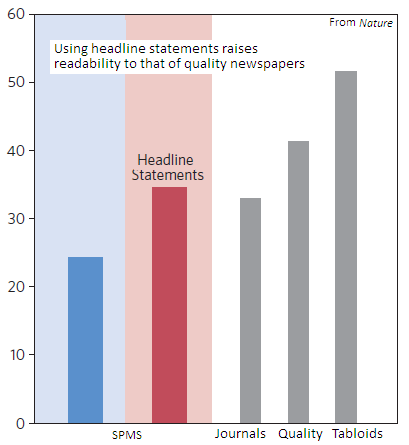
|
Readability levels One use of reading ease scores is to find what audience would be comfortable with the writing. Readers’ Digest is said to have FRE score of about 65, Time magazine about 52. Children’s books, typically score above 80. But even easy language can score low by the Flesch formula if the subject matter calls for longer sentences to make the meaning clear. FRE of any text passage can be calculated by most word processing software, simply by enabling ‘readability statistics’ under ‘options. The FRE score of this article, for instance, is 42.7. Readers may like to respond to say at what level of difficulty or ease they would place the article, in the categories shown in the table. |
>
|---|
------------------------------------------------------------------------------------------
Do respond to : response@simplescience.in